
Illustrator Gabriel Foligno Photographer Catherine Ivill Publication Getty Images
The Underlying Stats Behind Arsenal's Progress Under Mikel Arteta
The perception of Arsenal’s season has changed dramatically in the past few weeks. For much of the campaign, they were heralded for their coterie of exciting young players who had been assembled, coached, and assimilated within an astute…
The perception of Arsenal’s season has changed dramatically in the past few weeks. For muchof the campaign, they were heralded for their coterie of exciting young players who had beenassembled, coached, and assimilated within an astute tactical framework established by theirequally compelling and youthful head coach, Mikel Arteta.
Now, as they let a top-four finish slipby in a demoralizing display at White Hart Lane and a tame defeat to Newcastle United, they’vebeen lambasted for yet another season of underachievement and disappointing displays froman inconsistent and mentally brittle squad.
The Gunners undoubtedly lost out on a golden opportunity to return to Europe’s premiercompetition; and whether it’s in the dressing room, the transfer market, or their finances, theyare bound to suffer the consequences.
That, though, should not come to define their season.Their progress under Arteta has been evident, and ought to be applauded as the first signs ofgenuine forward momentum for the club since Arsene Wenger retired.Arsenal’s underlying metrics make this evident.
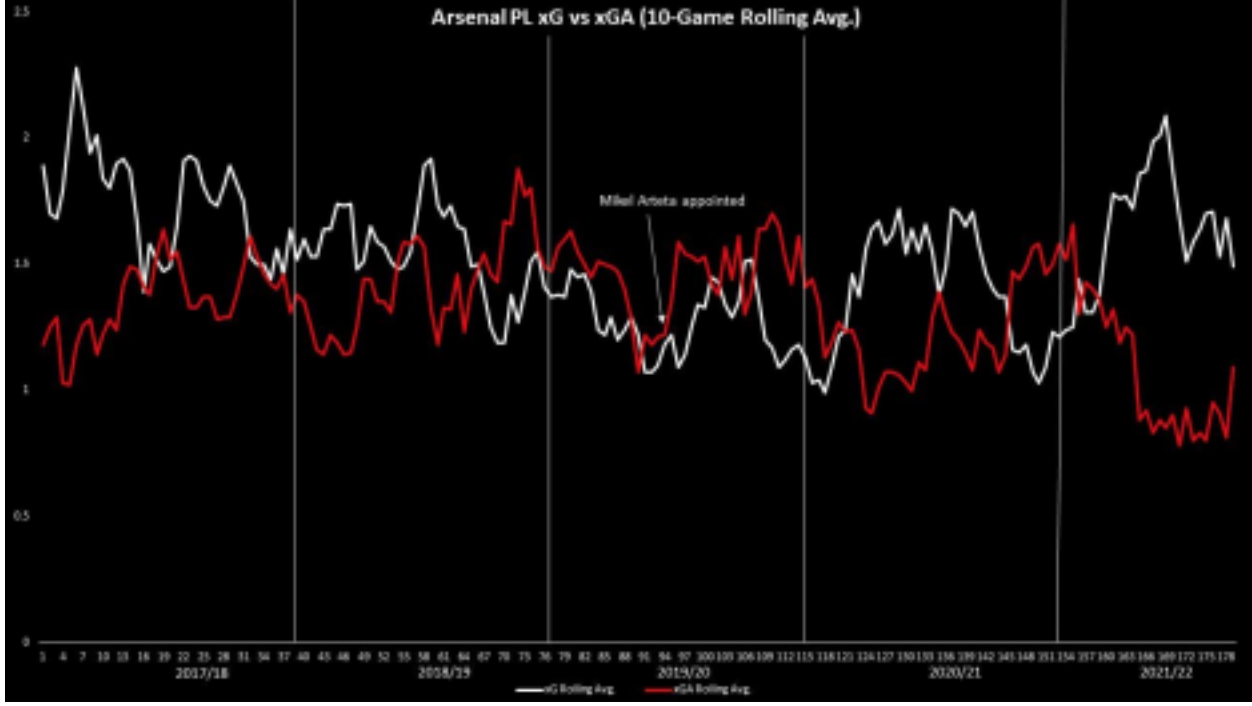
Data sourced from: FBRef. xG is expected goals, which measures the quality of a chance by calculating the likelihood each shot ateam takes will be scored based on its location, phase of play, and other factors. xGA, is expected goals, measures the quality ofchances a team conceded using the same process.
The above graphic displays Arsenal’s expected goals versus their expected goals against in thePremier League since the 2017/18 season.
It compares the quality of chances they created withhow well they prevented the opposition from creating opportunities, providing a simple yetinstructive illustration of how well the Gunners performed across various seasons.
The 2020/21 campaign saw a marked and fairly consistent improvement in Arsenal’s expectedgoals against, and they’ve since built upon that by further bolstering both their defensive andoffensive performance.
Defensive Improvement
A few factors have coalesced to produce Arsenal’s defensive improvement. Arteta settling on aback four and a clear first-choice backline has given the team greater defensive continuitycompared to last season, where system and personnel were frequently changed.
Therecruitment of Takehiro Tomiyasu at right-back has also given the team a more aeriallydominant and defensively reliable fullback option than Hector Bellerin and Cedric Soares inprevious years.
Takehiro Tomiyasu: A Transformative Cog in Mikel Arteta’s Youth Revolution
Arteta also deserves credit for his tactical improvements to Arsenal’s defensive posture.Specifically, he’s improved the intelligence and intensity with which they press in theopposition half and given the team a solid structure which they can fall back on when the pressis broken or cannot be sustained.
In previous years, Arsenal have lacked a solid defensive shape they could trust for prolongedperiods of the game. Their midfield and defensive lines would be too spaced out, and when theball was switched from one flank to the other, the Gunners would usually struggle to shiftacross in time and with sufficient men to smother the opposition attacks.
Due to their disjointedshape, players would often make rash decisions in an effort to cover space and men that couldnot be controlled by the team as a whole, further hurting Arsenal’s defensive capabilities.In their 2-1 defeat to Manchester City in January, Arsenal displayed the progression they madein the defensive phase.
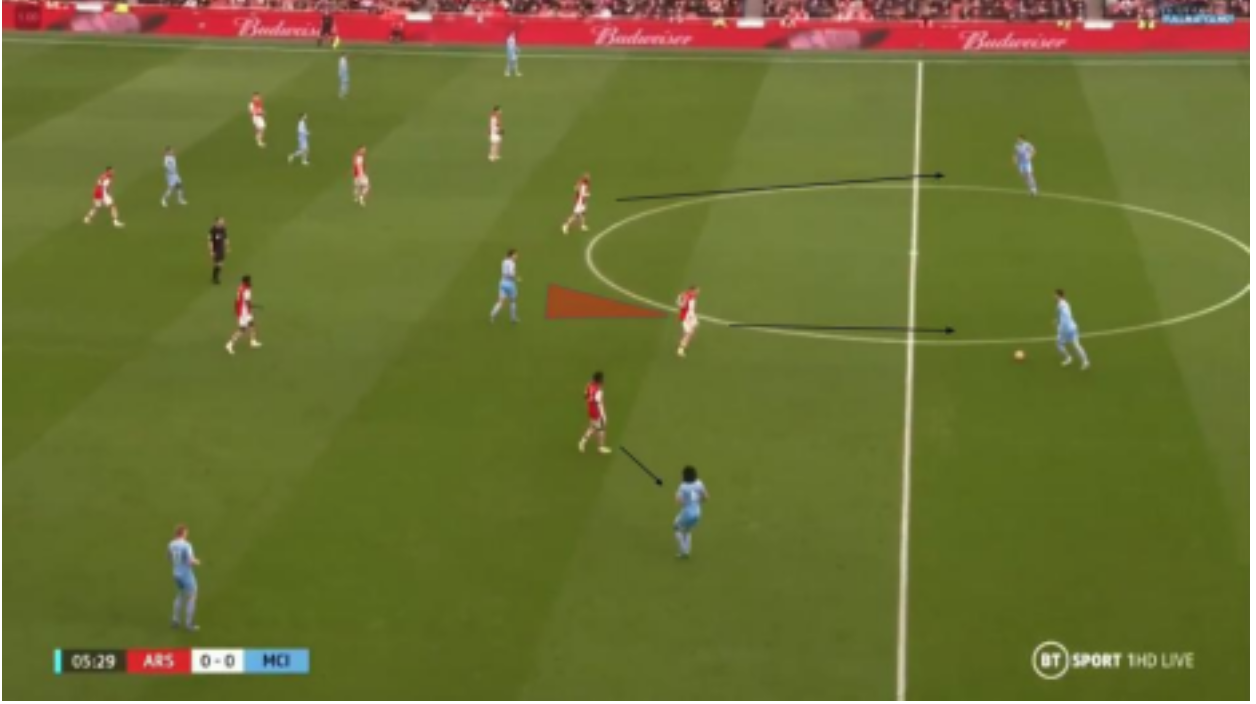
As can be seen in the above image, there is minimal space between the midfield and defensivelines, making Arsenal harder to play through and denying City players space and time inbetween the lines. Martin Odegaard is intelligently positioned to both apply pressure toAymeric Laporte while also preventing the pass into Rodri with his cover shadow.
Bukayo Sakaand Alexandre Lacazette are also in prime positions to apply pressure to the two City playersclosest to Laporte, the man on the ball. It’s also noteworthy that as Laporte opens his body tothe right side of the pitch, Arsenal have enough width in their structure to shift across but nottoo much as to leave too much space horizontally between their players.
For Arteta, this defensive structure is not just an asset in and of itself: it facilitates Arsenal’spressing game. No team has the physical or tactical capacity to press high for ninety minutes,so by ensuring Arsenal can endure periods of the game where they are more passivedefensively, Arteta has increased the efficacy with which they press.
As Mark Carey of the Athletic pointed out, while general pressing metrics portray Arsenal as arelatively ineffective pressing team, this is merely a reflection of how they have minimalpressures in the defensive and middle third of the pitch but are extremely aggressive inpressuring the opposition in the attacking third.
Their principles behind the press are fairly standard: they look to block central passing optionsto force the opposition out wide, using the touchline as an additional defender to make it easierto retrieve the ball.
Martin Ødegaard: Mikel Arteta’s Creative Metronome and Mesut Özil’s Long-Term Replacement
In fact, the majority of Arsenal’s defensive progression has stemmed fromseemingly rudimentary improvements -- better spacing between defenders, greater awarenessof when to press, and tighter marking of opposition players -- rather than creative tacticalinnovations.
However, these ostensibly simple elements of defending are the consequence of meticulous,repetitive training ground drills which Arteta has had to guide the squad through.
Given histime at Everton under David Moyes and at Rangers, it’s no surprise he has embraced similarlyprosaic yet effective means to improve Arsenal’s defending. The Spaniard’s success inimplementing such methods is a testament to his range of abilities as a head coach.
Offensive Improvement
Arsenal’s improved attack is mainly the consequence of Arsenal’s intelligent recruitment,Arteta’s subtle tactical adjustments, and his faith in the club’s young talent.
Soon after he was appointed, Arsenal were visibly better at playing out from the back. Theirbuild-up structure provided them with better passing angles and greater numerical superiority toretain and progress possession under pressure.
However, they continually struggled to movethe ball into dangerous areas in the final third, create high-quality chances, and generate shots.
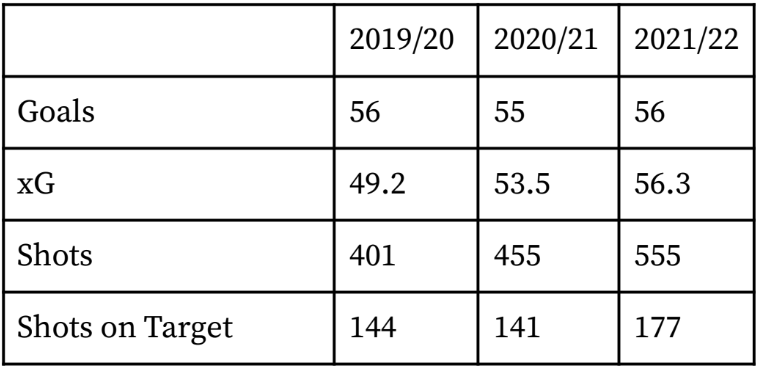
The table above shows that while Arsenal have scored a similar number of goals in the pastthree years, they are taking more shots and creating higher-quality chances as per their xG thisseason. Arteta has strengthened the foundations of their attack and made their offensive outputmore sustainable.
In the 2019/20 season, Arsenal were hugely reliant on Pierre-Emerick Aubameyang for theirgoal-scoring. He scored 22 of the club’s 56 goals despite recording an xG of just 15.8, anoverperformance of 6.2 which accounted for almost all of Arsenal’s xG overperformance as ateam.
Rather than being reliant upon one elite finisher who can convert chances at anunexpectedly high-rate, Arsenal are now creating better chances. Moreover, the acquisitions of Ben White and Aaron Ramsdale in the summer window drastically improvedArsenal’s ability to build out from the back.
Ramsdale is extremely comfortable bringing outthe ball from goal-kicks and has an impressive passing range. White is similarly adept with hisshort, medium, and long-range passing as well as being composed and controlled whencirculating the ball under pressure.
Along with Gabriel and Thomas Partey, the two signings provide a solid foundation forArsenal’s build-up, allowing Arteta to push his fullbacks and midfielders higher up the pitchrather than coming deep to assist ball progression.
As a result, Arsenal are able to commitmore men to attacking play and more easily create overloads to overwhelm the opposition.Granit Xhaka in particular has been reinvented from a deep-sitting progressive midfielder to amore orthodox number eight to facilitate this.
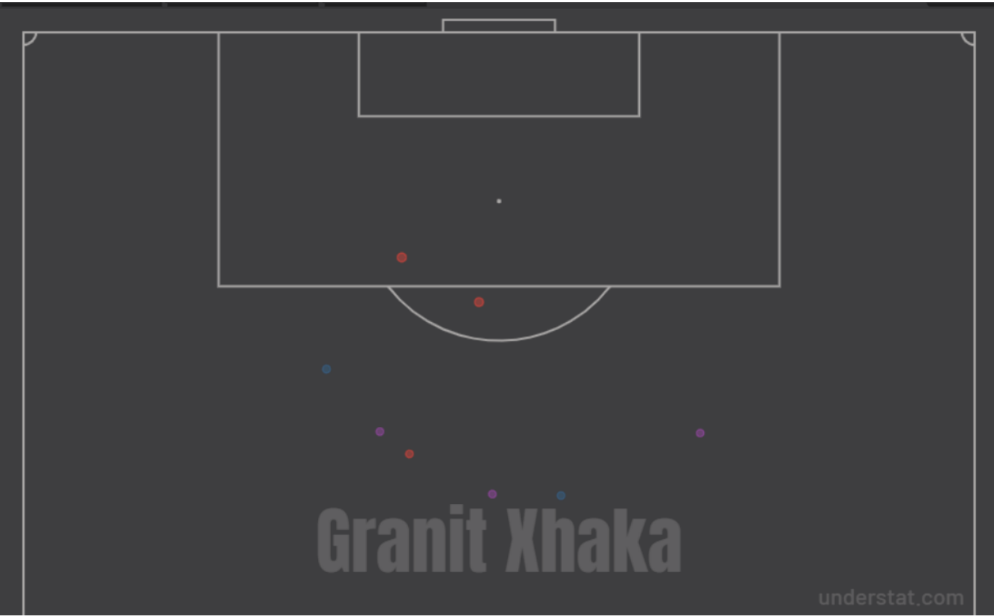
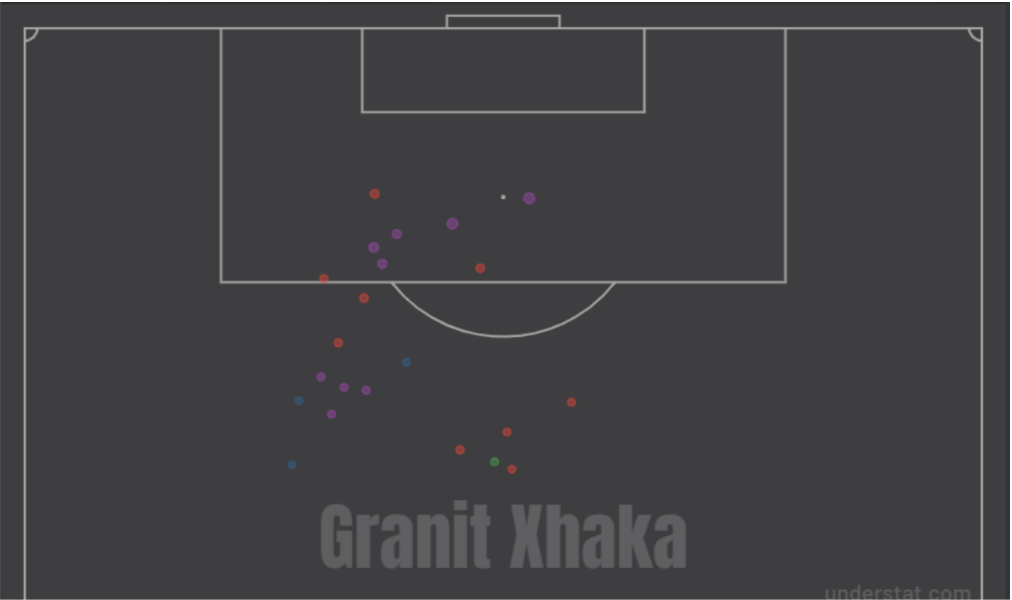
This shot maps from Understat show all of Granit Xhaka’s open-play shots in the Premier League inthe 2020/21 and 2021/22 seasons respectively. It’s clear that Xhaka is taking more shots than lastseason and that the majority of them are being taken closer to goal.
His game is not naturallysuited to this role, but by pushing Xhaka into a more advanced role, Arteta gives Arsenalanother player to participate in quick one-twos and create overloads in the attacking third tohelp the team create more chances.
Another player whose role has changed under Arteta has been Alexandre Lacazette. While never asprolific as Aubameyang, the Frenchman was purchased and initially deployed as a traditionalnumber nine.
Under Arteta, though, his primary task has moved from goal-scoring to droppingdeep to link play and making runs to create space for Arsenal’s other attackers.
Specifically,Arsenal look to create space in the inside channels for Bukayo Saka, Martin Odegaard and one of Gabriel Martinelli or Emile-Smith Rowe to take shots. Arteta’s continued faith in these youngplayers has not only enabled them to progress individually, but has also fostered impressiveattacking chemistry between them.
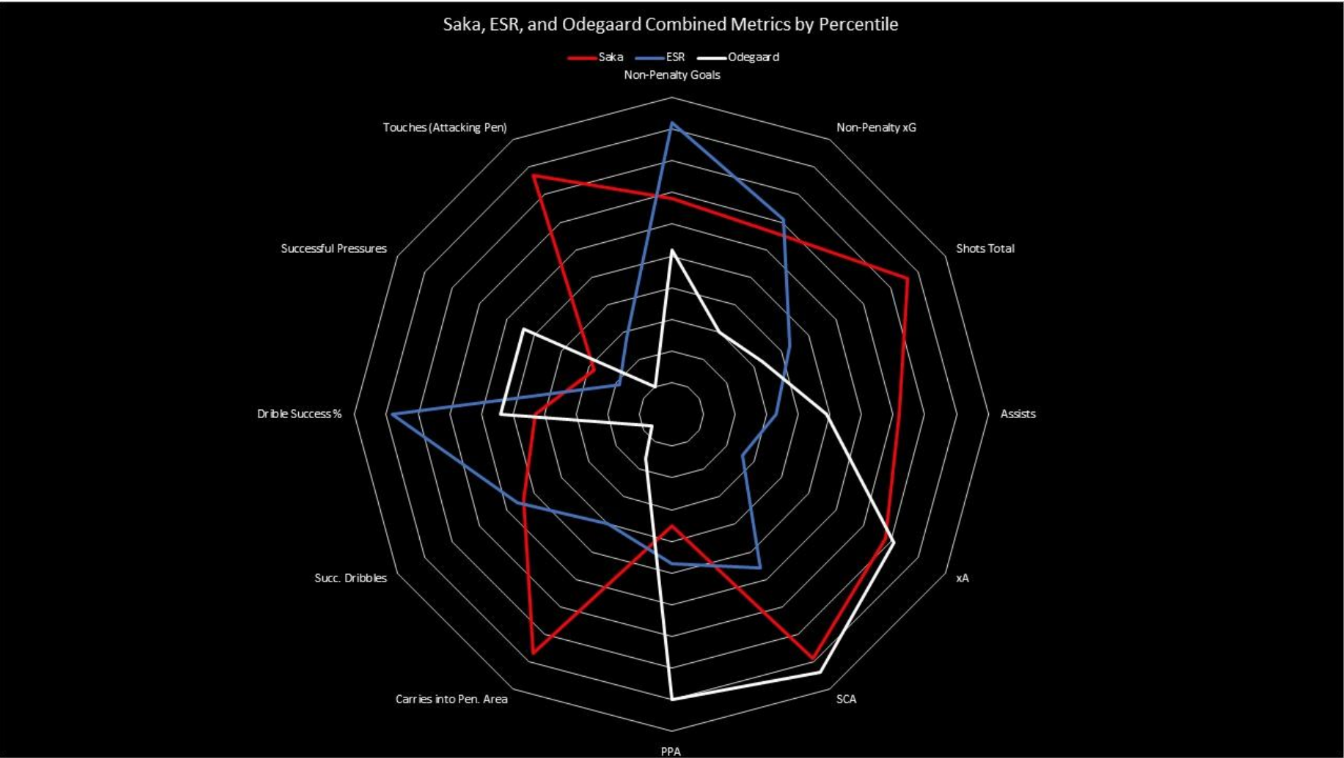
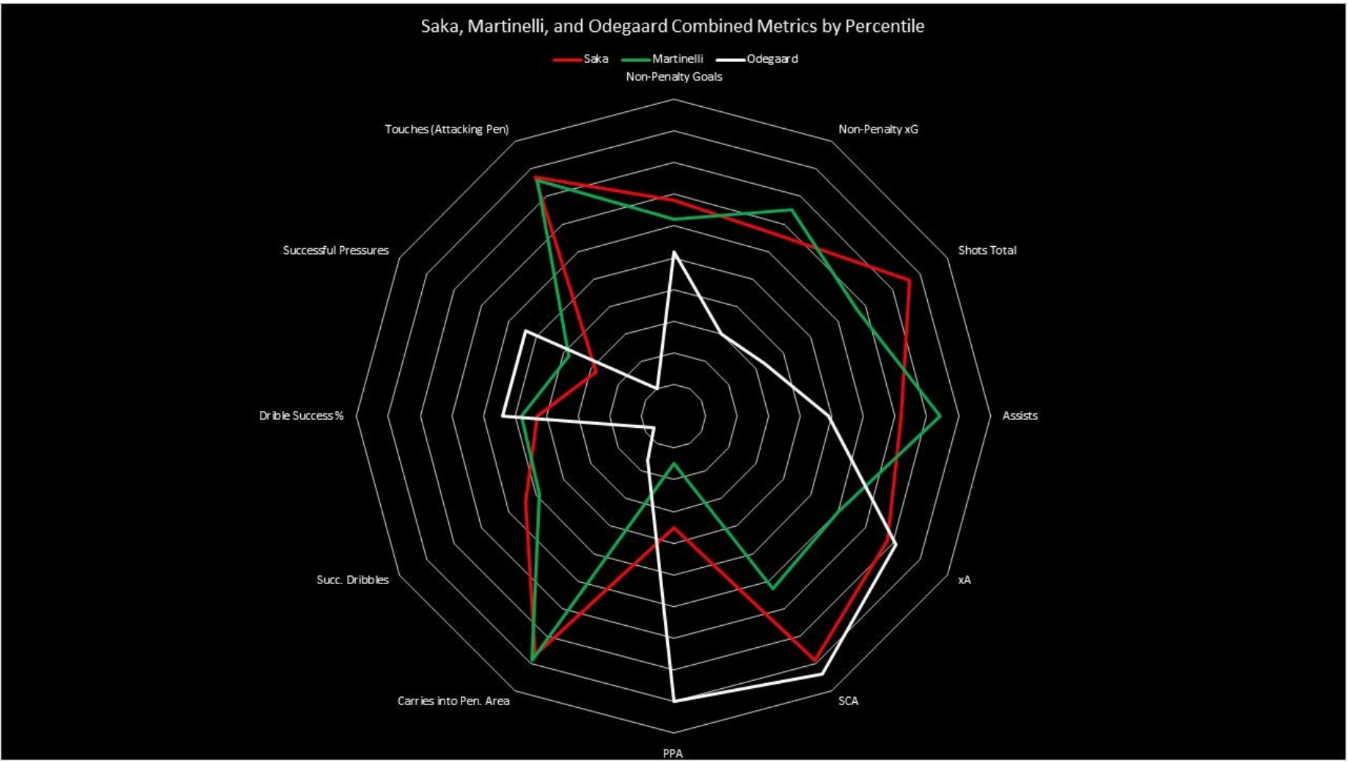
As shown by the above radars, Arsenal have a fairly complete attacking lineup with anycombination of Saka, Odegaard, and one of Smith-Rowe or Martinelli.
Not only are theyimpressive talents in isolation, but their specific strengths also complement each other well. Odegaardin particular is able to bring a level of creativity, control, and precision to Arsenal’s attack whichhelps unlock the dynamism and explosiveness of Martinelli, Smith Rowe, and Saka.
As theirpartnerships have blossomed over the course of the season, Arteta has been able to makeArsenal’s attack less-predicated on rigid, constricting passing sequences and instead givenmore license for his attackers to be positionally fluid and unpredictable. He’s found a moreoptimal balance between granting players freedom and providing them guidance with tacticalinstruction.
What Arsenal’s attackers lack is clinical finishing. The squad requires a higher quality forwardthan Lacazette to create a genuinely complete front unit.
Even though the 30-year-old is notexpected to be the sole goal-threat, his 0.2 goals per 90 from 0.4 xG per 90 is simply not of thenecessary quality to make Arsenal a genuine top-four side.
Breaking Down Arsenal’s 2003/04 Invincible Season
Arsenal need a forward who canreplicate his work-rate and link-play while also posing as a more clinical finisher. Even withoutsuch a forward, though, he has already made noticeable strides in restoring the attackingidentity back to Arsenal.
While their inconsistency throughout the season, slew of red cards, and disappointing finish tothe campaign will undoubtedly frustrate fans, this is the consequence of entrusting a youngteam and young coach to lead the club.
The drawback is that when the stakes get higher and thepressure intensifies, mistakes are bound to be made as a product of inexperience. Arsenal havehad a number of issues this year and will be faced with new ones in the 2022/23 season.
Arteta undoubtedly benefited from the additional time on the training ground afforded by notplaying European football this year, and next season, he’ll need to become better at preparingfor games with less time.
The players will also need to adapt to less recovery time and morerotation, with reinforcements being necessary to add depth to a relatively thin squad. Therecruitment in the summer will need to be prudent, while previous signings will need to eithermaintain or improve their form.
Deja Vu – Arsenal’s Worst Premier League Campaign
Ramsdale in particular deserves scrutiny, as his shot-stopping has regressed as the season hascontinued. The best metric to evaluate goalkeepers is post-shot expected goals minus goalsallowed, which compares the expected number of goals a keeper would concede based on thequality of shots they face and the number of goals they actually conceded.
A positive numberindicates a keeper is performing above average and vice versa. Ramsdale’s post-shot expectedgoals minus goals allowed sits at a worrying -4.6. He is arguably still a net-positive to the teamgiving his commanding presence from set-pieces, vocal leadership, and impressivedistribution.
However, for Arsenal to be regular contenders for the top four and eventually higherhonors, his shot-stopping must improve. Whether Arteta can confront this and the aforementioned challenges Arsenal will face remain to be seen, and based upon the end to thisseason, soma fans may be skeptical.
Nevertheless, placing the future of the club in the hands of a young squad and coach is that it’sgiven the Gunners a new lease of life. For years, Arsenal were aimless, chasing some vaguelydefined yet essentially unclear shadow of their former selves.
Now, they have a clear identityonce again: defined by entrusting youth and attractive, progressive football. The players asindividuals and the squad as a collective are making concrete improvements, and they will onlycontinue to make more.
Aaron Ramsdale: Arsenal’s Long-Term #1?
Progress is rarely linear, but with the caliber of talent Arsenal possessand their fairly stable financial resources, they are on course to make steady improvementupon their current standing.
At the head of that improvement is Arteta, the bridge between Arsenal’s glory years underWenger and a modern vision for how to replicate such success in the future.
His appointmentwas the start of a long-term project and Arsenal need to be judged as such: a flawed work inprogress that may yet take some years to bear fruit, but which has already shown promisingglimpses of what the future may hold.
Arsenal may have missed out on Champions Leaguefootball, but in keeping faith in Arteta and his players, they may come to achieve so muchmore.
Credits
Words
Vishnu Anandraj